Synology Vmm the Cluster Is Not Ready Please Try Again Later
I've been using Veeam Backup and Recovery in my production environment for a while at present, and in hindsight, information technology was one of the all-time investments we've ever made in our IT infrastructure. It has completely changed the operational overhead of protecting our VMs, and the data they serve upwards. Using a data protection solution that utilizes VMware'due south APIs provides the simplicity and flexibility that was always desired. Moving abroad from array based features for protection has enabled the protection of VMs to better reflect desired RPO and RTO requirements – not past the limitations imposed by LUN sizes, assortment capacity, or functionality.
While Veeam is extremely uncomplicated in many respects, it is too a versatile, feature packed application that can be configured a variety of unlike ways. The versatility and the features tin can be a little confusing to the new user, so I wanted to share 25 tips that will help make for a quick and successful deployment of Veeam Backup and Recovery in your surround.
First lets become over a few assumptions that will be the basis for my recommendations:
- At that place are 2 sites that need protection.
- VMs and data need to be protected at each site, locally.
- VMs and data demand to exist protected at each site, remotely.
- A NAS target exists at each site.
- Quick deployment is important.
- You've already read all of the documentation.

Architecture
There are a number of different ways to ready the architecture for Veeam. I volition show a few of the simplest arrangements:
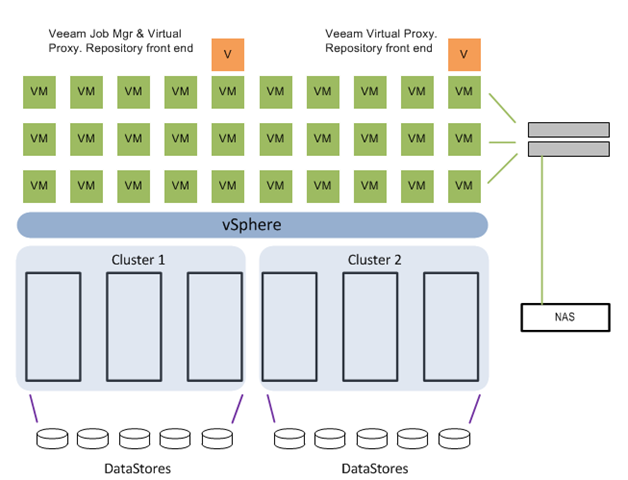
In this arrangement beneath there would be no physical servers – only a NAS device. This is a simplified arrangement of what I employ. If i wanted a rebuilt server (Windows or Linux) acting purely as a storage target, that could be in place of where you see the NAS. The architecture would stay the same.

Optionally, a physical server not just acting every bit a storage target, just also equally a physical proxy would expect something like this beneath:

Below is a combination of both, where a physical server is acting as the Proxy, just like the virtual proxy, is using an SMB share to house the data. In this case, a NAS unit.

Implementation tips
These tips focus not so much on ultimately what may suite your surround best (merely you know that) or leveraging all of the features inside the product, just rather, getting you up and running as quickly equally possible so yous tin get-go returning cracking results.
Job Manager Servers & Proxies
ane. Take the job Manager server, any proxies, and the backup targets living on their own VLAN for a dedicated backup network.
two. Set up SNMP monitoring on whatever physical ports used in the fill-in arrangement. It will exist helpful to understand how utilized the physical links get, and for how long.
3. Brand sure to requite the Chore Manager VM plenty resources to play with – especially if information technology volition take whatsoever data mover/proxy responsibilities. The deployment documentation has adept data on this, but for starters, brand information technology 4vCPU with 5GB of RAM.
iv. If at that place is more than one cluster to protect, consider building a virtual proxy inside each cluster that information technology will exist responsible for protecting, then assign it to jobs that protect VMs in that cluster. In my case, I use PernixData FVP in ii clusters. I take the data stores that house those VMs only accessible past their ain cluster (a constraint of FVP). Considering of that, I have a virtual proxy living in each cluster, with backup jobs configured and then that information technology volition employ a specific virtual proxy. These virtual proxies have a special setting in FVP that will instruct the VMs being backed upward to flush their write cache to the backing storage
Storage and Design
five. Keep the design simple, fifty-fifty if you know you will demand to accommodate at a later time. Architectural adjustments are piece of cake to do with Veeam, and then go alee and go Veeam pointed to the target, and start running some jobs. Apply this fourth dimension to get familiar with the production, and begin protecting the jewels as apace as possible.
6. Let Veeam use the default SQL Server Express instance on the Veeam Chore Manager VM. This is a very reasonable, and simple configuration that should exist acceptable for a lot of environments.
7. Question whether a concrete proxy is needed. Typically physical proxies are used for one of three reasons. ane.) They offload job processing CPU cycles from your cluster. ii.) In simple arrangements a Windows based Physical proxy might also be the Repository (aka storage target). iii.) They allow for one to leverage a "directly-from-SAN" feature by plugging in the system to your SAN textile. The terminal one in my opinion introduces the near hesitation. Here is why:
- Some storage arrays do non have a "read-simply" iSCSI connection type. When this is the case, special care needs to be taken on the physical server directly attached to the SAN to ensure that it cannot initialize the data store. The reality is that you are i mistake away from having a very long day in front of you. I do not like this option when there is no secondary prophylactic machinery from the assortment on a "read-only" connection type.
- Straight-from-SAN access can be a very good method for moving data to your target. And then adept that it may stress your bankroll storage plenty (via link saturation or physical disk limits) to mayhap interfere with your production I/O requirements.
- Additional efforts must be taken when using write buffering mechanisms that do non live on the storage array (e.g. PernixData) .
8. Veeam has the ability to back up to an SMB share, or an NFS mountain. If an NFS mount is chosen, brand sure that information technology is a storage target running native Linux. Most NAS units like a Synology are indeed just a tweaked version of Linux, and information technology would be easy to conclude that one should only use NFS. Nevertheless, in this instance, y'all may run across ii problems.
- The SMB connection to a NAS unit will probable be faster (which near certainly is the showtime fourth dimension in history that an SMB connexion is faster than an NFS connexion) .
- The Chore Manager might non be able to manage the jobs on that NAS unit of measurement (connected via NFS) properly. This is due to BusyBox and Perl on the Synology not really liking each other. For me, this resulted in Veeam being unable to remove sun setting backups. Irresolute over to an SMB connection on the NAS improved the performance significantly, and allowed for job handling to work as desired.
ix. Veeam has a great new feature (version vii.10) called a "Backup Copy" job, which allows for the backup made locally to be shipped to a remote site. The "Backup Copy" job achieves one of the about basic requirements of data protection in the simplest of means. Two copies of the data at two different locations, simply with the do good of only processing the backup chore once. It is a new feature of Version vii, and although information technology is a nifty feature, it behaves differently, and warrants some time spent before putting into production. For a speedy deployment, it might be all-time merely to configure 2 jobs. One to a local target, and one to a remote target. This will give you the time to experiment with the Backup Re-create chore characteristic.
x. At that place are compelling reasons for and confronting using a rebuilt server as a storage target, or using a NAS unit. Both are attractive options. I concluded using a dedicated NAS unit. It's form cistron, drive bay count, and the overall cost of provisioning was the only pick that could match my requirements.
Operations
11. In Veeam B&R, "Replication Jobs" are different than "Backup Jobs." Instead of trying to effigy out all of the nuances of both right away, utilise simply the "Fill-in chore" function with both local and remote targets. This will give you time to ameliorate understand the characteristics of the replication functionality. One also might find that the "Fill-in Chore" suites the surroundings and need better than the replication option.
12. If there are daily backups going to both local and offsite targets (and y'all are not using the "Fill-in Copy" selection, have them run 12 hours apart from ane another to reduce RPOs.
13. Build up a exam VM to practise your testing of a backup and restore. Restore it in the many ways that Veeam has to offer. Best to understand this at present rather than when you really need to.
14. I like the task chaining/dependency feature, which allows you to concatenation multiple jobs together. But remember that if a job is manually started, it will run through the rest of the jobs too. The easiest style to suit this is to temporarily remove it from the job concatenation.
15. Your "Backup Repository" is just that, a repository for information. It tin can be a Windows Server, a Linux Server, or an SMB share. If you don't have a NAS unit, stuff an sometime server (Windows or Linux) with some drives in information technology and it will piece of work quite well for y'all.
16. Devise a unproblematic, articulate job naming scheme. Something similar [BackupType]-[Descriptive Proper noun]-[TargetLocation] volition speedily tell yous what it is and where it is going to. If yous utilise folders in vCenter to organize your VMs, and your backups reflect the same, you could also choose to use the folder proper noun. An example would be "Fill-in-SharePointFarm-LOCAL" which quickly and accurately describes the job.
17. Start with a uncomplicated schedule. Say, once per mean solar day, then lookout the daily backup jobs and the synthetic fulls to encounter what sort of RPO/RTOs are realistic.
eighteen. Repository naming. Be descriptive, but come up with some naming scheme that remains clear fifty-fifty if you aren't in the application for several weeks. I similar indicating the location of the repository, if it is intended for local jobs, or remote jobs, and what kind of repository it is (Windows, Linux, or SMB). For example: VeeamRepo-[LOCATION]-for-Local(SMB)
19. Repository system. Create a expert tree structure for organization and scalability. Veeam will do a very expert job at handling the organisation of the backups one time you assign a specific location (share name) on a repository. However, create a structure that provides the ability to continue with the same naming convention as your needs evolve. For case, a logical share name assigned to a repository might be \\nas01\backups\veeam\local\cluster1 This organisation allows for different types of backups to live in unlike branches.
twenty. Veeam might prevent the ability of creating more than one repository going to the same share name (it would see \\nas01\backups\veeam\local\cluster1 and \\nas01\backups\veeam\local\cluster2 as the aforementioned). Create DNS aliases to fool information technology, then make those two targets something like \\nascluster1\backups\veeam\local\cluster1 and \\nascluster2\backups\veeam\local\cluster2
21. When in uncertainty, leave the defaults. Veeam put in great efforts to make certain that you, or the software doesn't trip over itself. Uncertain of job number concurrency? Stick to the default. Wondering almost which fill-in mode to utilize? (Reverse Incremental versus Incrementals with synthetic fulls). Stay with the defaults, and save the experimentation for later.
22. Don't overcomplicate the schedule (at least initially). Veeam might give you flexibility that you never had with array based protection tools, but at the aforementioned time, there is no need to make it complicated. Perhaps group the VMs by something that yous can keep runway of, such as the folders they are contained in within vCenter.
23. Each backup job tin be adapted so that whatever target you are using, you can optimize it for preset storage optimization type. WAN target, LAN target, or local target. This can easily be disregarded, merely volition make a deviation in fill-in performance.
24. How many backups you can proceed is a function of change range, frequency, dedupe and compression, and the size of your target. Aye, that is a lot of variables. If cypher else, find some storage that can serve every bit the target for say, ii weeks. That should requite a pretty good sampling of all of the above.
25. Accept one item/characteristic once a week, and spend an hour or two looking into information technology. This will allow you to find out more most say, Changed block tracking, or what the application aware prototype processing feature does. Your reputation (and peradventure, your job) may rely on your ability to recover systems and data. Come up with a scattering of scenarios and see if they work.
Veeam is an extremely powerful tool that will simplify your layers of protection in your environment. Features similar SureBackup, Virtual Labs, and their Replication offerings are all very good. But more than likely, they do not need to be a part of your initial deployment plan. Stay focused, and go that new backup software up and running as speedily as possible. You, and your system, will be better off for it.
– Pete
Source: https://vmpete.com/2014/02/25/practical-tips-for-a-veeam-backup-and-recovery-deployment/
0 Response to "Synology Vmm the Cluster Is Not Ready Please Try Again Later"
แสดงความคิดเห็น